When a sun hat carries a “UPF 50+” tag, buyers tend to read it as a marketing flourish rather than a measured number. It is a measured number, and understanding what it actually certifies — and, just as important, what it does not — is the difference between ordering hats that genuinely protect the people wearing them and ordering hats that only look the part. For any brand putting its name on headwear for a resort, an outdoor event, or a field crew, the sun-protection spec deserves the same scrutiny as the logo. Here is how the rating works, how it is tested, and how to specify a hat that earns the claim.
What UPF measures, and how it differs from SPF
UPF stands for Ultraviolet Protection Factor, and it describes how much ultraviolet radiation a fabric lets through to the skin beneath it. The number is a ratio: a UPF 50 fabric admits one-fiftieth of the UV that hits it, which means it blocks 98 percent and lets 2 percent through. A UPF 30 fabric lets through one-thirtieth, blocking about 96.7 percent. The scale is usually grouped into bands — 15 to 24 is rated good, 25 to 39 very good, and 40 to 50-plus excellent — and the ceiling is conventionally capped at “50+” because differences above that are negligible in practice.
The crucial distinction is from SPF, the number on a sunscreen bottle. SPF measures only UVB rays and is based on burn time, an estimate of how much longer treated skin can stay in the sun before reddening. UPF measures both UVA and UVB and reflects radiation blocked by the material itself, with no dependence on how a person’s skin reacts, whether they sweat, or how long ago they last reapplied anything. A hat does not wear off or need topping up, which is exactly why sun-protective fabric is such a reliable layer — and why the UPF number, unlike an SPF claim on skin, holds steady all day.
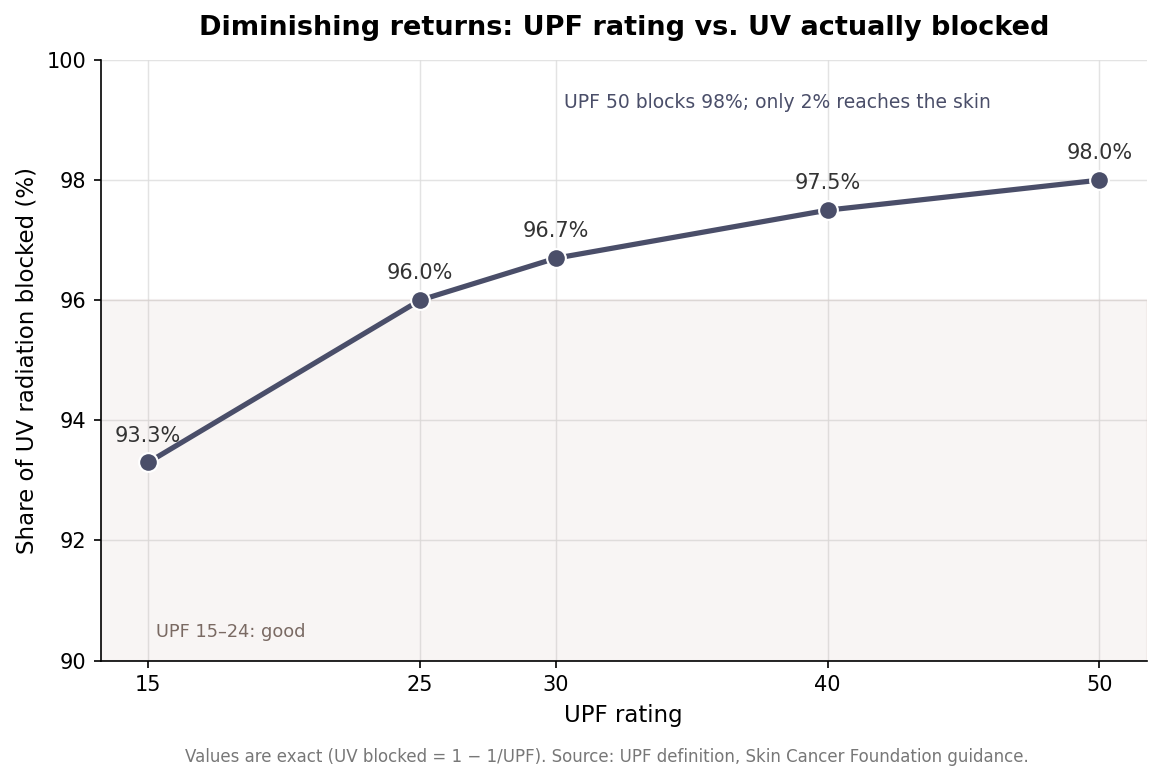
The chart above also shows why chasing an ever-higher number has limited value. Moving from UPF 30 to UPF 50 improves blocking from roughly 96.7 to 98 percent — real, but a small absolute gain. The bigger failures in the field are almost never a fabric that tests at 40 instead of 50; they are gaps in coverage, thin or stretched cloth, and hat styles that leave whole regions of skin in the sun.
What makes a fabric protective
UPF is a property of the finished material, and several factors move it. Weave density is the biggest lever: tightly woven or knitted cloth leaves less space between yarns for UV to slip through, which is why canvas, denim, and dense synthetics outperform loose, sheer straws and open weaves. Hold a fabric up to a light — the more light you see through it, the more UV passes too. Color matters because darker and more saturated dyes absorb UV rather than letting it through, so a black or deep-navy hat generally protects better than a pale one of the same construction. Fiber plays a role: polyester and treated technical fabrics can carry UV-absorbing chemistry, while some natural fibers protect largely through their weave. And because a hat is a fixed shape rather than clothing stretched over a body, weight and finish tend to hold their rating better than a thin knit that thins further when pulled.
Two practical cautions follow. A loosely woven straw hat can look like the definition of a sun hat and still test poorly, because you can see daylight straight through the weave; if sun protection is the point, that style needs a tight weave or a lining. And a fabric’s rating can drop when it is wet or heavily stretched, so a hat that will be worn in surf or sweat should be specified with that in mind.
How the rating is tested
A credible UPF number comes from laboratory testing to a recognized standard, not from a supplier’s estimate. In the United States the relevant methods are AATCC 183 and ASTM D6603, and the Australian and New Zealand standard AS/NZS 4399 is widely referenced worldwide because those countries were early to regulate the claim. The test passes measured UV through the fabric and calculates the fraction blocked across the UVA and UVB range. When you order hats with a UPF claim, ask which standard was used and request the test report for the specific fabric and color, since dye and finish change the result. In the U.S. a UPF claim is a regulated marketing statement, so a supplier that cannot point to a test behind the number is a supplier to be cautious with. As a useful benchmark, a leading dermatology body grants its seal of recommendation only to fabrics that test at UPF 50 or above.
Coverage is where hats win or lose
Even a perfect fabric only protects the skin it actually shades, and this is where hat style and brim width decide the outcome. Guidance from skin-cancer specialists points to a brim of at least three inches all the way around to shade the face, the sides and back of the neck, and the easily forgotten tops of the ears. Four to five inches begins to cast shade onto the shoulders and upper chest, and beyond that you are protecting the upper arms for genuine all-day exposure. The geometry, not just the material, is doing the work.
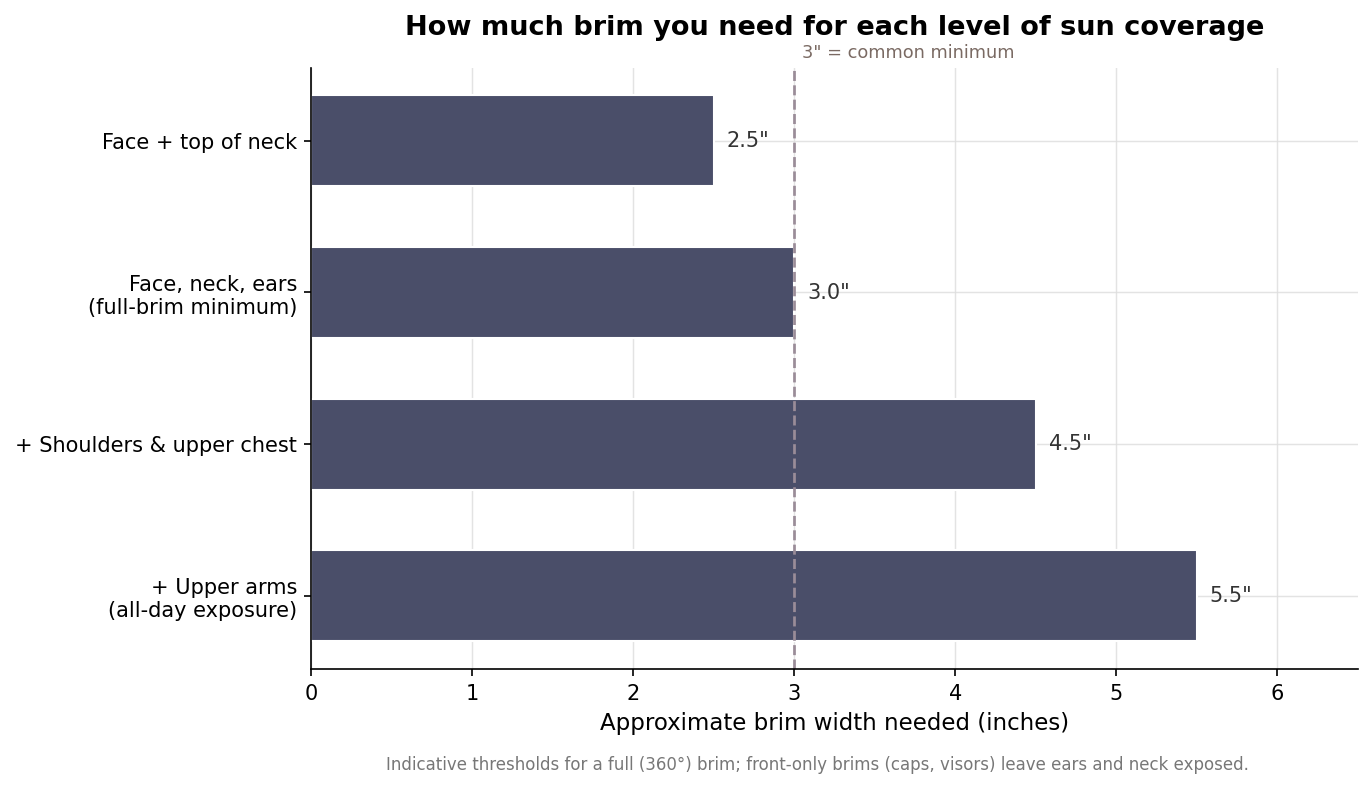
Style follows directly from that. A full, 360-degree brim — a wide-brim or a well-cut bucket — is the strongest all-round performer because it shades in every direction. A legionnaire style, with a front brim plus a neck flap, is a strong choice for field and marine work where the back of the neck takes a beating. The popular baseball cap and the visor, by contrast, shade only the face and, at best, a slice of it; they leave the ears, the sides of the face, and the whole neck exposed, which is why they are a weak choice when sun protection rather than branding is the real brief. The best specification pairs a fabric that tests at UPF 50 in the color you are ordering with a brim wide enough for the exposure the wearer will face — get both right, and the tag on the hat is a promise the hat can actually keep.