Ordering a run of branded sun hats for a resort, an event, or a giveaway looks straightforward until the hats arrive and someone points out that the logo is perfect but the hats barely shade anyone’s face. Sun hats are a product where the details that matter most are easy to overlook, because the thing you are really buying, protection from the sun, is not the thing you are looking at on screen, which is usually the color and the logo. These are the mistakes that turn up most often when brands order sun hats, and how to avoid each one before the order goes to print.
Choosing a brim too narrow to actually shade anything
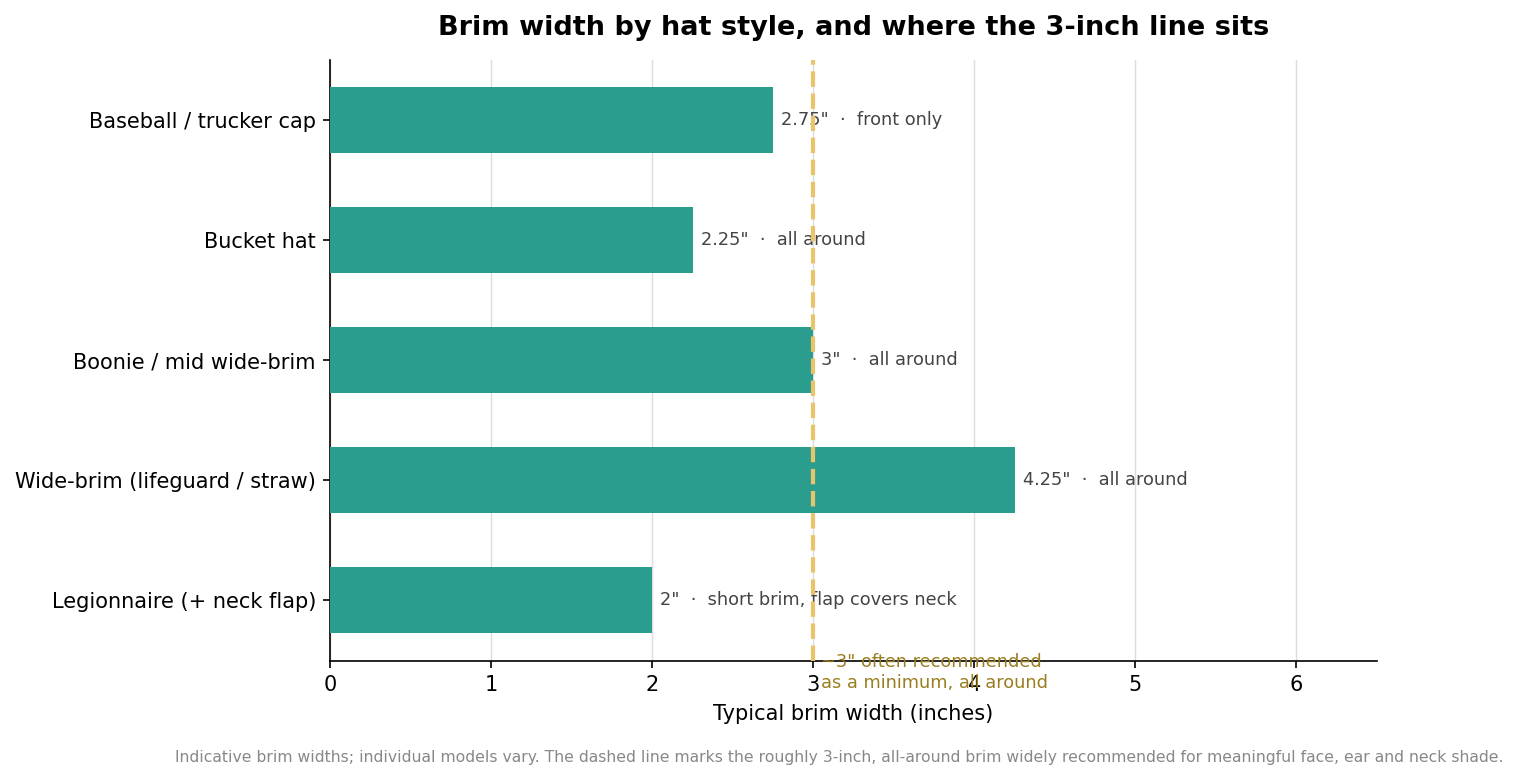
The single most common mistake is treating brim width as a style choice rather than a function. A narrow brim looks neat and photographs well, but it does very little for the ears and the back of the neck, which are among the most common sites for sun damage. Dermatology guidance generally points to a brim of at least about three inches, measured all the way around, as the threshold for meaningful shade across the face, ears, and neck. As the chart above shows, a lot of popular styles sit below that line. A bucket hat at two to two and a half inches covers the face well but leaves the neck partly exposed, and a baseball cap shades only the face from the front. If sun protection is the point of the product, three inches all around is the number to design toward, and anything less should be a deliberate trade for a specific look rather than an accident.
Assuming the style covers more than it does
Related to brim width is the assumption that any hat labeled a sun hat protects the whole head equally. It does not, and the differences are stark once you map them out. The grid below shows roughly which areas each common style shades under midday sun. A baseball cap leaves the ears, neck, and shoulders fully exposed, which is why it is a poor choice for anyone spending hours outdoors even though it is the default promotional hat. A legionnaire style makes an interesting trade, keeping the front brim short but adding a fabric flap that covers the neck and ears, which can outperform a wider brim for back-of-neck coverage on a boat or a beach.
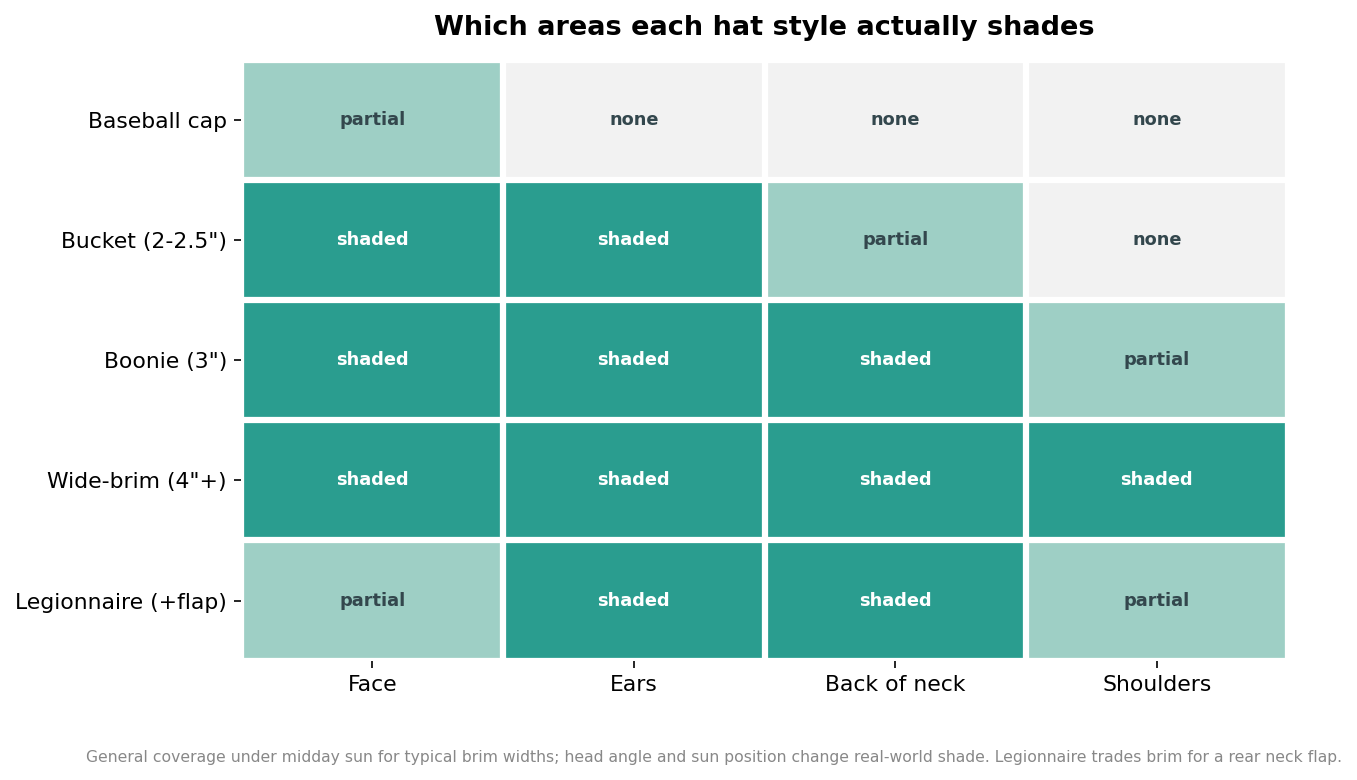
The practical lesson is to match the style to where the hat will be worn and what needs covering. For a poolside resort where guests face in all directions, a wide, even brim earns its size. For a fishing charter or a trail crew where the sun mostly comes from behind, a legionnaire flap or a boonie with a longer rear brim solves the real problem better than a fashionable narrow brim ever will.
Treating “one size fits all” as if it were literally true
Many blank sun hats are sold as one size, and for a giveaway that is often fine, but it is worth knowing that one size usually means a fitted band somewhere in the mid-range of adult head sizes, roughly 22 to 23.5 inches in circumference, held by an internal drawcord or an elastic sweatband. That range leaves out both smaller and larger heads, and a hat that will not stay on is a hat that gets left behind. For a mixed audience, an adjustable toggle or a drawcord widens the usable range considerably. For anywhere windy, and resorts and beaches are windy, a chin cord is not a luxury; a hat with no way to secure it will end up in the water, and the brand impression goes with it. Specifying an adjustable fit and a chin cord costs little and rescues a lot of hats from being unwearable for part of your audience.
Picking a decoration method that will not survive the conditions
Sun hats live a hard life outdoors, exposed to UV, sweat, sunscreen, and often salt water, and not every decoration method holds up to that. Embroidery is the most durable option for a logo on a structured hat because the design is stitched into the fabric and does not fade or peel, though it adds cost and does not reproduce fine detail or gradients well. Screen printing and direct printing handle color and detail better and suit soft, packable, or straw-textured hats where embroidery would pucker, but a cheap heat-applied transfer can crack, lift, or discolor after repeated sun and sweat exposure. The mistake is choosing the decoration for the artwork alone without asking whether it will still look good after a summer of real use. For a hat meant to last a season or more, favor embroidery on structured styles and a properly cured print on soft ones, and be wary of low-cost transfers for anything that will bake in the sun.
Confusing color and comfort with actual UV protection
A final, subtler mistake is assuming that a light color or a loose weave equals sun safety. Color and ventilation affect how hot the hat feels, and a light-colored, well-ventilated hat is genuinely more comfortable in heat, but comfort is not the same as UV blocking. What determines how much ultraviolet light actually passes through the fabric is the tightness of the weave and, where it is treated for it, the hat’s UPF rating, not its color. A loosely woven straw hat can let a surprising amount of sun through the crown even while it feels cool and looks protective. If sun protection is a selling point of your hats, specify a tight weave or a rated fabric and hold the color and ventilation decisions separately, as comfort features rather than protection features. Get the brim, the fit, the decoration, and the fabric right, and the branded hat does both jobs at once: it carries your logo and it actually protects the person wearing it.